

Donald Trump apparently needs another civics lesson.
Unfortunately, you and I may get stuck paying the tuition.
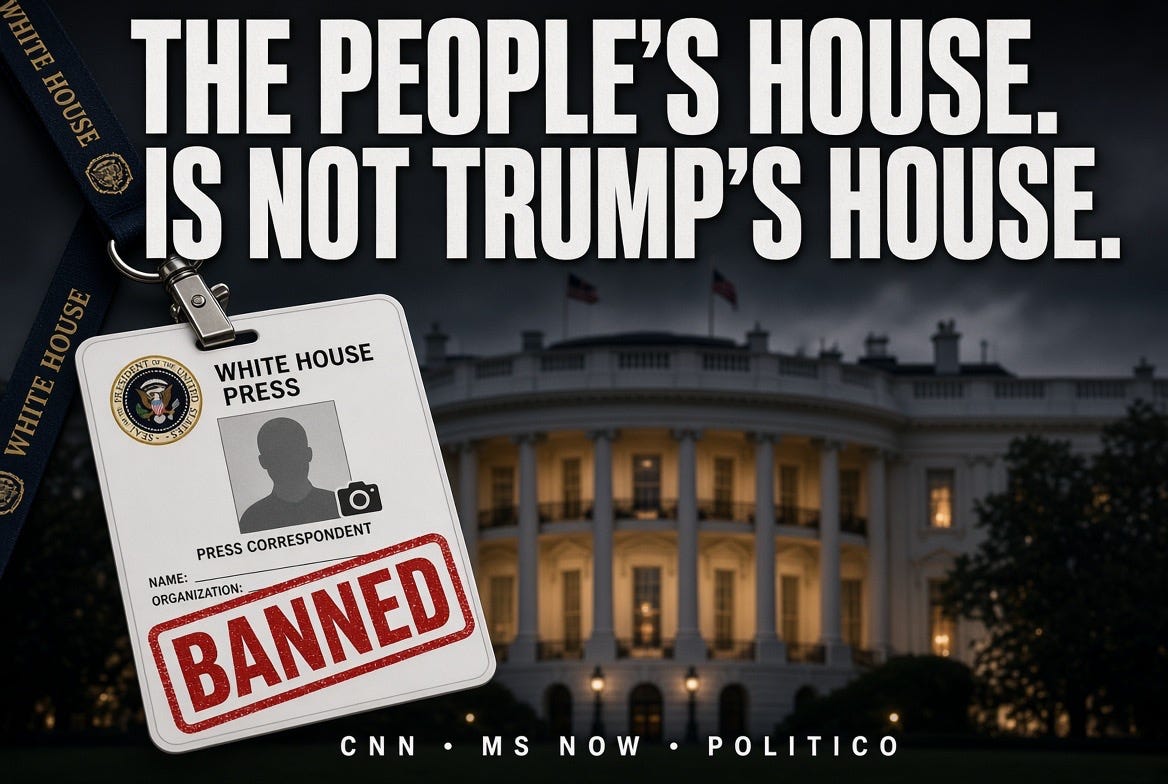
Yesterday, Trump announced that he was banning CNN, MS NOW and Politico from the White House, accusing them of reporting “fake news” and “fiction and lies.”
Asked why?
Not because their reporters presented a security threat.
Not because they violated some neutral credentialing rule.
Not because they broke into the building.
Because Trump doesn’t like their journalism.
And when asked whether other news organizations might be next, Trump specifically brought up The New York Times and The Washington Post.
Stop right there.
THIS IS NOT OK.
The White House is not Trump Tower.
The press room is not Mar-a-Lago.
And the President of the United States does not get to turn access to the seat of the American presidency into a loyalty program where favorable coverage earns admission and unfavorable coverage gets you thrown outside the gates.
There is a name for punishing someone because the government dislikes what they say:
Viewpoint discrimination.
And the First Amendment exists for precisely the kind of moment when the person holding enormous government power decides he would prefer not to be questioned by people who disagree with him.
THERE IS ALREADY CASE LAW ON THIS
Trump has been down this road before.
During his first administration, the White House revoked CNN correspondent Jim Acosta’s press credential.
CNN sued.
A federal judge ordered the White House to restore it while the litigation proceeded, finding that Acosta had not been afforded the process required before his credential was taken away.
Then came the Associated Press.
Last year, the Trump White House restricted AP access after the news organization refused to adopt Trump’s preferred name, “Gulf of America,” in place of its existing usage of Gulf of Mexico.
The AP sued.
U.S. District Judge Trevor McFadden — a judge appointed by Donald Trump — issued a preliminary injunction against the administration.
His reasoning could hardly be more relevant today:
When the government opens White House spaces to journalists, it cannot exclude a news organization from that access because of its viewpoint.
That ruling has been fought on appeal, and the courts have recognized an important distinction: the President has greater discretion when choosing which reporters get into genuinely limited spaces such as certain Oval Office events or small press pools.
But that is very different from announcing that entire news organizations are simply “banned from the White House” because you don’t like what they report.
And this isn’t some newfangled interpretation invented because Donald Trump is president.
The controlling D.C. Circuit precedent dates back to 1977.
In Sherrill v. Knight, the federal appeals court held that although the White House does not have to establish press facilities in the first place, once it does, access for bona fide journalists cannot simply be denied arbitrarily or because government officials dislike their speech.
There are also due-process protections before credentials can simply be taken away.
In other words:
A president does not get to create a government press room and then turn it into a fan club.
AND NOW WE MAY GET TO PAY FOR THIS AGAIN
Here is the part that should infuriate taxpayers regardless of whether they watch CNN, MS NOW, Fox News or nothing at all.
If CNN, MS NOW or Politico challenges these bans, who defends the White House?
Government lawyers.
Who pays those lawyers?
We do.
Who pays for the Justice Department resources, briefs, hearings, appeals and government personnel required to defend presidential actions in federal court?
We do.
Who pays if this fight climbs through the federal appellate courts?
We do.
There isn’t some special Donald Trump Constitutional Litigation Fund sitting underneath the Resolute Desk.
It is the United States government.
Which means it is our government.
Our lawyers.
Our resources.
Our tax dollars.
And we could once again watch those resources consumed litigating a constitutional fight created because the President of the United States decided that critical journalism should cost a news organization its access.
That is an important distinction: nobody can responsibly tell you today exactly what these potential lawsuits will cost, or guarantee how a court will resolve every aspect of White House access.
But litigation isn’t free.
And neither is repeatedly forcing federal courts to determine where presidential power ends and constitutional protections begin.
AND LOOK AT THE PATTERN
This isn’t happening in isolation.
Trump’s White House previously restricted the Associated Press after a dispute over its editorial language.
The administration subsequently changed the traditional press-pool system, reducing the guaranteed position historically occupied by the three major wire services:
Associated Press.
Reuters.
Bloomberg.
Now Trump says:
CNN.
MS NOW.
Politico.
And when asked who else might be next, he mentioned:
The New York Times.
The Washington Post.
That doesn’t mean every one of these organizations has been subjected to the same restriction. They haven’t.
It means Americans should pay very close attention to the governing principle being asserted:
The President believes unfavorable journalism is a legitimate reason to deny journalists access to their government.
That principle is far bigger than CNN.
It is bigger than Politico.
It is bigger than Donald Trump.
